

Limerence on Ice
On Heated Rivalry, Four Weddings and a Funeral, and Jane Austen's Persuasion

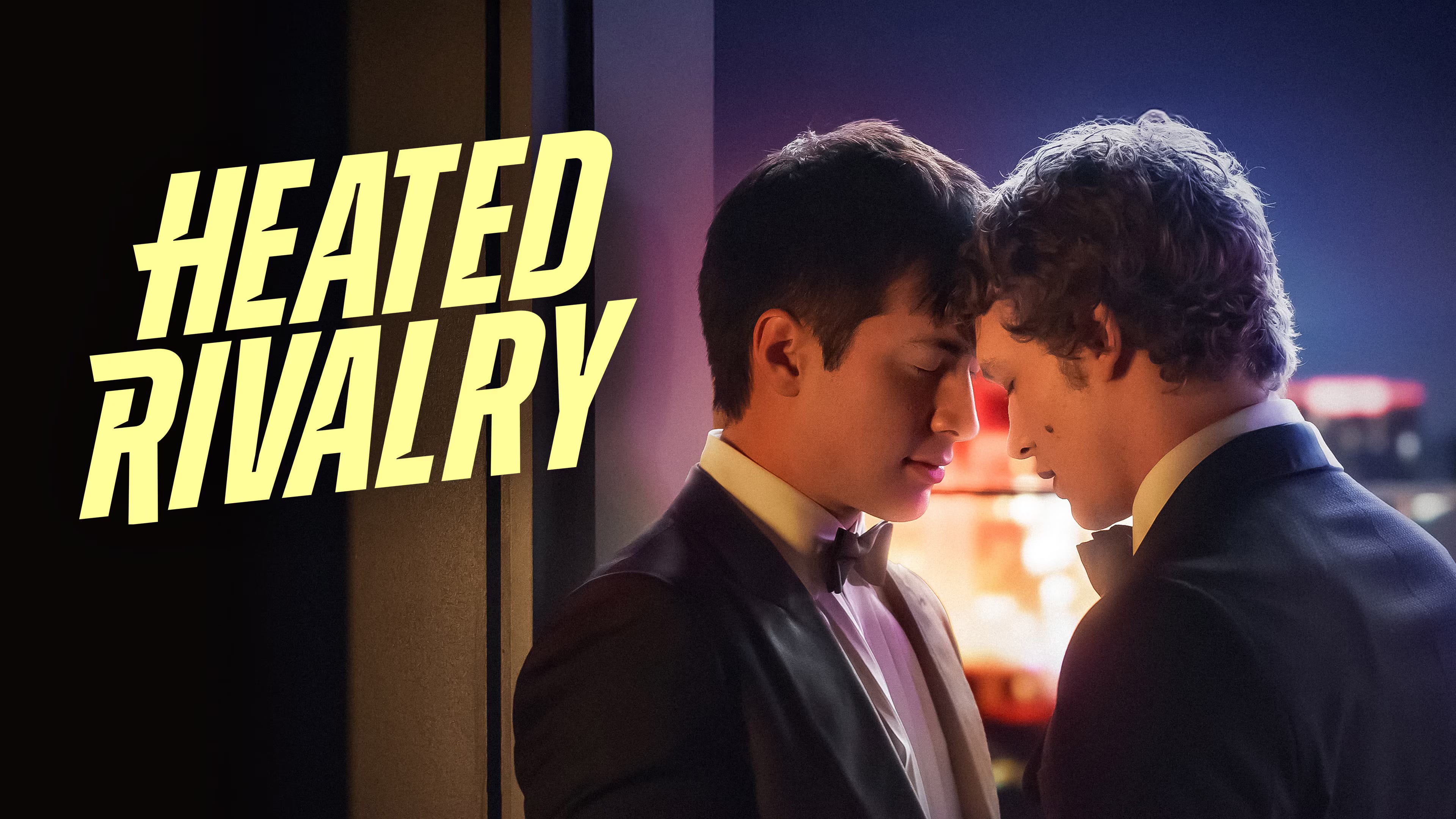
I finished my fourth binge a few nights ago, and I don’t see myself stopping anytime soon. I’m hardly an early adopter. My daughter read the Game Changer series in a covid-induced fog at the height of the pandemic, and watched the premier the first night it dropped on HBO. For months she begged me to watch, but I demurred. “I’m not interested in smut, gay or otherwise, and I do not give the slightest shit about hockey.” It wasn’t until my friend Monique leapt on the bandwagon that I finally decided to give Heated Rivalry a shot.
I was all in from the very first scene. Shane’s expression of eager bonhomie, Ilya’s surly disdain, and the unmistakable frisson of erotic tension between them. There is no doubt that the show is titillating, and not because (at the risk of being guilty of the crime of objectification) Conner Storrie has one of the best behinds I’ve ever seen, a true hockey player ass. And not because it is graphic. It actually isn’t. The eroticism resides in what it leaves to the imagination. Never has a bent leg implied so much with such efficiency.
I’m not watching it over and over, and then watching clips on Instagram Reels for hours every night, for the smut. I’m in it for the kissing. And the not kissing. (See episode 2. If you are not laid waste by that single unsent text I don’t know what to say to you.)
I have never watched a show four times in the span of a single week, or even twice. I’ve only ever watched a handful of television shows more than once, and then only because I had lied to my husband about not watching them and was forced to rewatch while unconvincingly pretending it was my first time in order not to be accused of television infidelity. (I was caught out each time and duly dressed down.) There are, in fact, only two narrative works other than Heated Rivalry which I have ever had such an insatiable thirst to re-experience: the movie Four Weddings and a Funeral, and Jane Austen’s Persuasion.
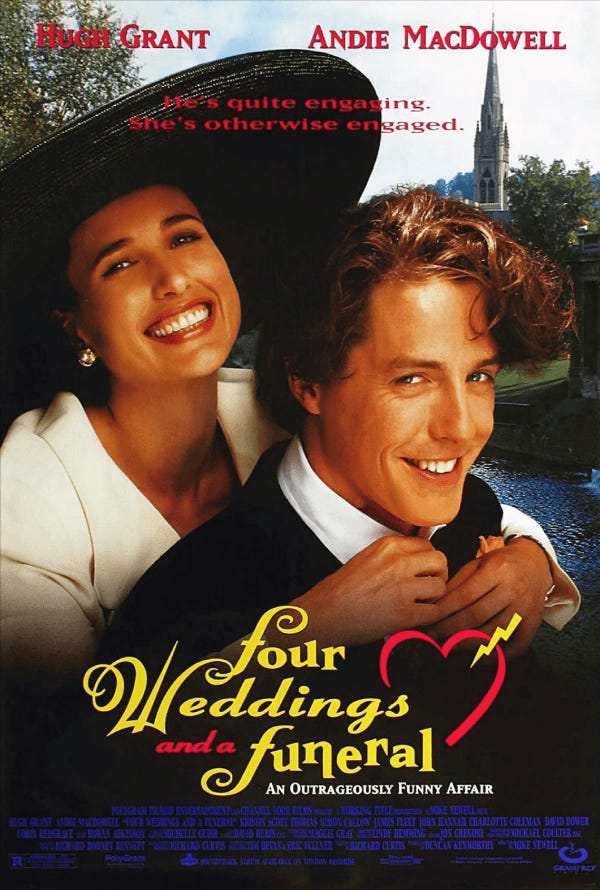
In Four Weddings, two people meet at a wedding, sleep together, and then proceed over the course of two more weddings and a funeral to miss one another, in a depiction of wrong-place-wrong-time that would be laughable if it weren’t so heart-tugging. In the final wedding (spoiler alert but come the fuck on the movie came out 32 years ago. If you haven’t seen it by now, you never will) our hero leaves another woman at the altar to finally be with our heroine.
In Persuasion, our sweet and unassuming heroine is persuaded (get it?) by a well-meaning but intrusive and misguided maternal figure to reject the suit of a young man of limited means, only to have him return years later, wealthy, successful, and furious that her malleability and weakness caused him so much pain. (Don’t worry, they get married in the end.)
I’ve spent the past couple of days puzzling out what the three have in common and have come to the conclusion that it’s not merely the romance, but the longing, the yearning that they share that makes it possible, even necessary, for me to go back for more. But why? I am a 61-year-old woman who has been in love for 33 years with her husband. Never once have I yearned for romance outside of my marriage. (Go forth and polycule all ye polyfolk. This one man is all I need.) So why do I yearn for yearning? (Sorry, I couldn’t resist).
At the risk of sounding like a nineteen-year-old who spends too much time on Tik Tok, I think the three evoke a similar emotional state: limerence. Limerence, a termed coined by psychologist Dorothy Tennov in 1979, is defined as an involuntary cognitive and emotional state of intense romantic desire for another person, the all-consuming experience of “being in love.” Limerence, Tennov says, is characterized by intrusive, obsessive thinking about the limerent object. You can’t stop thinking about them, you experience euphoria when reciprocation seems possible and despair when it doesn’t.
Limerence, even or perhaps especially when it is painful, bathes our brain in dopamine, that feel-good neurotransmitter associated with addiction. In 2005, biological anthropologist Helen Fisher studied brain scans of college students taken while they were looking photos of someone special to them, someone with whom they were “in love,” and compared them to scans of the students looking at a photograph of a mere acquaintance. Photos of the objects of their love and desire made the regions of the brain rich with dopamine light up.
Moreover, anyone who has taken Intro Psych or trained a dog knows that intermittent reinforcement, sporadic and unpredictable rewards rather than consistent ones, are the most addictive. They release the most dopamine.
In real life, yearning can cause pain. You might be rejected! But pain, perversely, can be delicious. It makes the getting of your heart’s desire so much more satisfying. As my friend Yael Goldstein Love, a novelist and psychologist, explains, desire requires absence. It is the state of anticipation, when the possibility of perfection exists before the intrusion of reality. When we do actually get the object of our desire, it’s never the ideal “true merging” in which we are never lonely or unhappy again. It’s complex and sometimes painful. We are still who we are, with all our insecurities and dissatisfactions, even when we are loved and love. But in my three preferred artistic narratives, I get to experience the full neurochemical cocktail of longing, a hit of that delicious pain, all that dopamine, with none of the consequences.
There’s more.
In exploring why Heated Rivalry is so satisfying, Esther Perel describes it as a “beautiful corrective experience,” more satisfying on repeated watching even than on the first. (Another spoiler alert. Sort of.) Every time you expect something bad to happen, it doesn’t. None of your sickening fears are realized. Your lover pulls away from you, but then he comes back. You come out to your parents and they respond by apologizing to you. The first time you watch the show you are anxious; you fear the worst. Will they be hurt? Will they be exposed? But then after that, Perel says, on your second, third, fourth, twentieth watch, it is like “stroking a teddy bear.” And oh lord do we need a corrective experience right now, when the world around us is filled with so much misery, violence, and hate.
Perel has left us without the promised Part 2, a discussion of what we can understand about female sexual desire from what we women experience watching gay sexual desire, but we know from researcher Lucy Neville that the majority of women who get pleasure from watching gay porn describe their attraction as growing out of the belief that, unlike in heterosexual porn, both actors actually seem to be enjoying themselves, and that “the sexual desire and pleasure between them, therefore, felt more ‘authentic.’” I suppose that might be true. I can’t say. Heated Rivalry is the closest I’ve come to watching two men fuck, and as I said above, it is a masterpiece of subtlety and discretion disguised as smut.
More interesting to me is what the show has to say about masculinity. I found myself moved to tears when I read Wesley Morris’s review of the show, in which he writes:
The talking the men do here, and the smiling, dancing, hugging, spooning and thrusting, is speaking to women who perhaps need proof that tenderness still means something to a man. Every time I look into the face of some “Heated Rivalry” enthusiast, women mostly, what’s staring back at me isn’t a lot of ah-ooo-gah… It’s not even amour….What’s been staring back at me is a life response, a thank-God-I’m-in-here-instead-of-out-there-in-that-world response. It’s relief. In here, compassion exists. Women matter. Men heed them. Men heed and check on and care for one another. The sex isn’t simply positive. It’s love’s gateway.
This feels true to me. In a world where we’ve had to deal with the sickening realization that the conspiracy lunatics of QAnon were actually right, if not in the details than in their claim that a cabal of wealthy, powerful men were voraciously preying on children without accountability, a world in which a woman happily married for fifty years can discover that for nearly a decade her husband drugged her and brought at least seventy-two men into her bedroom to rape her, a world in which a serial predator was elected not once but twice to the most powerful political office in the world, it is as Morris says, a profound relief to see that some men (even fictional ones) can be soft, vulnerable, and respectful, both of their male lovers and of the women in their lives.
I am fortunate in that I get to experience that alternative manifestation of masculinity every day of my life, but as comforting as it is to know that my own man’s masculinity is the opposite of toxic, I still crave something that combats the reality going on outside my door.
I’m going to go watch the show for the fifth time now.
I feel incredibly sorry to be living in a country where there are strong rumors that anti-LGBTQI+ laws are about to be passed. I don’t think there is a single platform brave enough to stream it, but I’m keeping my fingers crossed. Meanwhile, every cis woman I know has pirated this show in Turkey. Thank you very much for this piece. I’ve become a subscriber.
This is a beautiful piece. Thank you for it. Four Weddings and a Funeral and Persuasion (the book and the 1995 BBC adaptation of the book with Amanda Root and Ciarán HInds), are central comfort art for me. I do "need proof that tenderness still means something to a man," that "compassion exists" in the reality I can't believe we are living. I haven't seen Heated Rivalry, but I agree that there is relief and reassurance when I expect something bad to happen, and it doesn’t. My favorite film last year was Sentimental Value, which sets the viewer up for a number of bad outcomes and then chooses different directions. After reading your piece I realize some of my gratitude to Joachim Trier for his artistic choices come out of my daily dread that yet more ugly things will go wrong, and break my heart more. Sentimental Value gave me just what I hoped for. It's interesting that you mention limerance, which I was reading about a few days ago for a separate reason. I do think we seek it out because it is soul-satisfying and calming, and allows us the delicious push and pull of yearning and love without the drop into daily reality. So lovely. Your piece is like a comfort interlude all its own.